The Death of 2D Seat Maps: Why Airlines Are Moving to Immersive 3D Experiences


Airlines are spending millions of dollars modernizing their websites. Sleek new homepages, faster load times, personalized recommendations — the digital transformation of aviation is in full swing. Yet one of the most critical moments in the entire customer journey remains stuck in the 1990s: The seat selection screen.
You know the one. A grid of blue and white squares, tiny icons for window or aisle, maybe a red "X" for occupied. It's functional, yes. But in an era where consumers expect rich visuals, immersive previews, and try-before-you-buy experiences, the 2D seat map is no longer enough.
Today's digital traveler wants to know exactly what they're paying for before they click "confirm." And airlines are finally waking up to that reality.
The Problem with 2D: A Legacy That's Overstayed Its Welcome
The traditional two-dimensional seat map is a relic of the legacy GDS (Global Distribution Systems) era. It was built for a different time — when booking a flight meant prioritizing utility over experience.
But consumer expectations have changed. Travelers now research destinations through immersive video content, browse hotels with 360° virtual tours, and expect the same level of visual transparency when booking a flight. The blue-and-white grid simply doesn't deliver.
Here's what's broken:
No sense of space. A square on a screen tells you nothing about legroom, seat width, or the actual feel of the cabin.
No differentiation. Standard seats, extra-legroom seats, and premium cabins all look the same on a 2D map.
No confidence. When passengers can't visualize their seat, they hesitate. And hesitation kills conversion.
As one industry observer put it, the 2D seat map transforms what should be an exciting moment — choosing where you'll sit on your journey — into a frustrating, uninformed guess.

The Rise of Immersive 3D: What's Changing
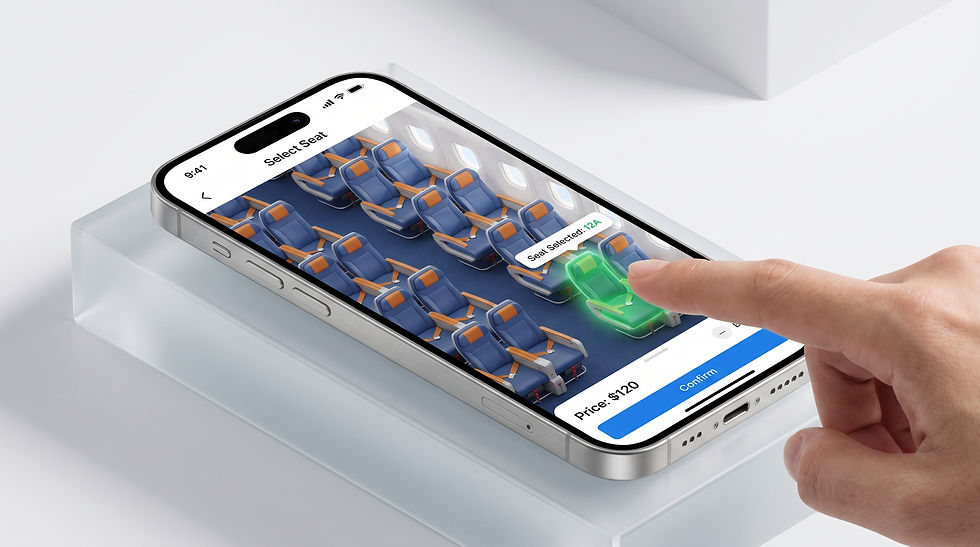
Forward-thinking airlines are moving beyond flat grids. They're embracing interactive 3D seat maps that let passengers explore the cabin like never before.
American Airlines recently began testing an interactive 3D seat map for its Boeing 787-9 aircraft, allowing customers to explore the cabin and get a true sense of their seat through immersive imagery and high-quality 3D cabin views. This isn't just a nice-to-have — it's a strategic move to reduce uncertainty and enhance pre-flight confidence.
And American isn't alone. Airlines including Emirates, United, Etihad, and Iberia have already integrated 3D seat visualization into their digital platforms. The message is clear: the industry is moving, and 2D is being left behind.
The Numbers Don't Lie
The business case for 3D visualization is compelling.
ATPCO's 2024 shopper survey revealed that 83% of flight shoppers prefer 360-degree cabin tours when selecting a seat or cabin. Passengers don't just want a seat — they want to understand the experience they're buying into.
The impact on conversion is equally striking. Airlines using 3D seat map technology report that more than 20% of users interact with the seat map tool, resulting in a 6% to 10% increase in conversion and sales of extra-room seating products.
When passengers can see the difference between a standard seat and an extra-legroom seat — when they can visualize the view from their window, the position of the bulkhead, or the layout of the cabin — they make more informed decisions. And informed decisions lead to higher satisfaction, fewer complaints, and greater ancillary revenue.
What We Do: Photorealistic 3D Visualization, Nothing More, Nothing Less
It's important to be clear about what we provide — and what we don't.
We are a 3D visualization company. Our expertise lies in creating photorealistic, web-based 3D cabin interiors and seat models that airlines can embed into their digital channels.
Photorealistic 3D design — Every detail, from seat materials and colors to window positions and cabin layout, is computer-generated to match the real aircraft with precision.
Web-based 360° interactivity (cubemap) — Passengers can explore the cabin from any angle, directly in their browser, with no plugins or app downloads required.
100% web technology — Fast loading, lightweight, and compatible with all devices.
What we don't do: We don't build booking engines. We don't handle payment processing. We don't manage ticket purchasing infrastructure.
Our role is strictly visual. Airlines integrate our 3D content into their existing booking flows using their own IT teams. We provide the immersive experience; they handle the transaction. It's a clean division that lets each party focus on what they do best.

Why This Matters for Passenger Experience (PaxEx)
The passenger experience — or PaxEx — has become a critical differentiator in the airline industry. With competition intensifying and ancillary revenue playing an increasingly important role, airlines can no longer afford to treat seat selection as a transactional afterthought.
3D visualization transforms seat selection from a chore into an experience. It builds trust. It reduces anxiety. It helps passengers feel excited about their journey rather than uncertain about their choice.
As one airline executive noted, "Customer engagement has increased quite a lot. The time customers spend when looking for a seat has increased, and satisfaction scores have increased because customers understand it better".
Digital Transformation in Aviation: The UI/UX Imperative
Digital transformation in aviation isn't just about back-end efficiency — it's about reimagining every customer touchpoint. And UI/UX is at the heart of that reimagining.
The 2D seat map is a UX failure. It asks passengers to make a purchasing decision based on insufficient information. It treats every seat as interchangeable when, in reality, no two seats are the same.
3D visualization fixes that. It provides the visual richness that modern consumers expect. It aligns the airline booking experience with the standards set by e-commerce giants. And it turns a moment of friction into a moment of delight.

The Future Is Immersive
The death of the 2D seat map isn't a prediction — it's already happening. Airlines that embrace immersive 3D experiences are seeing tangible results in conversion, customer satisfaction, and ancillary revenue. Those that cling to legacy interfaces risk falling behind.
At the end of the day, passengers don't book flights for the seat map. They book for the journey. But the seat map is where that journey begins — and first impressions matter.
It's time to give passengers a seat they can see, feel, and trust before they even step on board.
Interested in bringing photorealistic 3D cabin visualization to your airline? We provide the immersive experience — your IT team handles the rest. Let's talk.


Comments