Combatting 'Seat Surprise': Reducing Customer Complaints Through 360-Degree Transparency

The $1,000 View of a Blank Wall
Imagine paying a premium for a window seat, only to discover upon boarding that your "view" is a featureless cabin wall. No clouds. No cities. No sky. Just grey plastic.
This isn't a traveler's nightmare—it's a reality that has sparked class-action lawsuits against major carriers, with over a million passengers claiming they were misled into paying extra for seats that simply don't have windows. As one federal complaint filed stated: "When consumers choose to book an airplane seat adjacent to the wall, they expect it to have a window".
The industry has a name for this: "Seat Surprise." And it's costing airlines far more than refunds.

What Is "Seat Surprise"?
"Seat Surprise" encompasses every unexpected disappointment a passenger faces after boarding:
The phantom window: Selecting a window seat that faces a blank wall.
The non-reclining trap: Discovering your seat doesn't recline on a 9-hour overnight flight.
The missing legroom: Finding your "extra legroom" seat has less space than standard economy.
The blocked view: Sitting behind a bulkhead or galley that obstructs your experience.
These aren't rare occurrences. They're structural issues baked into aircraft configurations—and traditional 2D seat maps simply don't reveal them.
The Hidden Cost of "Seat Surprise"
Customer Satisfaction (CSAT) Takes a Nosedive
When passengers feel deceived, trust erodes instantly. A passenger who boards expecting one experience and receives another isn't just disappointed—they're angry. And angry passengers become:
Negative reviewers across social media and travel platforms
Reluctant to book with your airline again
More likely to demand compensation or file complaints
The math is simple: One unhappy passenger tells an average of 10-15 people about their negative experience. In the age of social media, that number multiplies exponentially.
Cabin Crew Bears the Brunt
Every "seat surprise" complaint lands on your cabin crew's shoulders. They're the ones who must:
Apologize for decisions made far above their pay grade
Attempt to find alternative seating on a full flight
Manage passenger frustration while maintaining safety protocols
Absorb verbal abuse from disappointed travelers
This constant friction increases crew burnout, reduces job satisfaction, and elevates turnover rates—all while your team is trying to deliver exceptional service.

Operational Inefficiency Mounts
Each complaint consumes valuable time:
Gate agents field questions before boarding
Cabin crew manage inflight dissatisfaction
Ground staff process post-flight compensation claims
Call centers handle follow-up complaints
This cascade of operational drag diverts resources from revenue-generating activities and increases your cost-to-serve.
The 360-Degree Solution: Visual Transparency
What 3D Seat Mapping Delivers
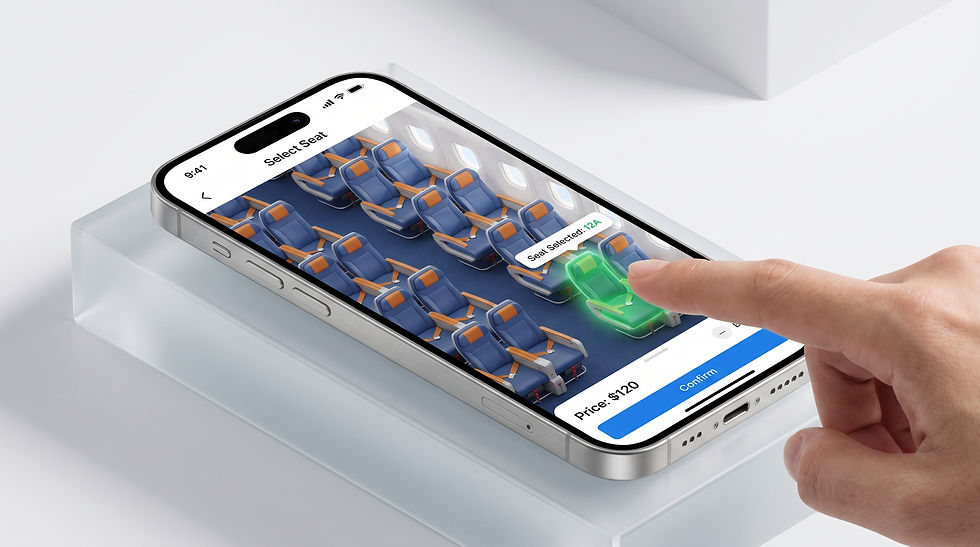
Modern 3D seat map technology provides passengers with photorealistic, interactive views of their exact seat from any angle—directly within the booking flow. This isn't a static 2D diagram. It's an immersive experience that answers every question before the ticket is purchased:
What does my view actually look like? See exactly what you'll see from your seat
Is there a window or a wall? The 3D render reveals the truth instantly
What's my legroom situation? Visualize the space before you commit
Am I near a galley or lavatory? Understand your seat's full context
As one industry leader noted, "Rich content gives travelers increased transparency around what they're getting". Airlines implementing these solutions are seeing "clear and quantifiable benefits of greater customer satisfaction".

Setting Realistic Expectations
Transparency is the ultimate trust-builder. With 360° seat visualization, you give passengers the confidence to book with certainty—not hope. Here is exactly what they see before they click "purchase":
Window alignment and structural seat design – no more "wall views" or awkward surprises
Cabin layout, bulkheads, and aisle proximity – full spatial awareness at a glance
Recline capabilities – no hidden limitations on long-haul flights
View obstructions – exactly what they will see from their window
The payoff? You eliminate preventable disappointments before they ever become complaints. When passengers know exactly what they are buying, their expectations meet reality at the door—boosting CSAT, protecting your brand reputation, and freeing your cabin crew to focus on hospitality, not damage control.
The Business Case for Transparency
Increasing Ancillary Revenue
When passengers can see the value of a premium seat, they're more willing to pay for it. Transparency doesn't just reduce complaints—it drives revenue by helping customers understand exactly what they're getting for their money.
Reducing Complaints
With 3D seat mapping, "nothing should come as a surprise". Passengers who know exactly what they're getting are far less likely to complain. As one aviation technology provider explains: "The airline can manage user expectations in a whole new way".
Building Brand Trust
In an era of heightened consumer awareness, transparency is a competitive advantage. Airlines that offer try-before-you-buy seat visualization demonstrate confidence in their product and respect for their customers.
Reducing Crew Stress
When passengers board with accurate expectations, cabin crew can focus on service instead of damage control. Less conflict means:
Higher crew morale
Better inflight service quality
Lower turnover
Reduced training costs for new hires
Implementation Considerations
Technology Integration
Modern 3D seat map solutions integrate seamlessly into existing booking flows—whether during initial reservation, check-in, or manage-my-booking functions. The technology is web-based, requiring no app downloads or special hardware.
Scalability
These solutions scale across your entire fleet. Each aircraft type and configuration can be rendered in photorealistic 3D, ensuring consistency across your operation.
Partnership Approach
Leading solutions are available through established travel technology partners, making implementation straightforward without requiring massive internal development resources.
The Bottom Line
"Seat Surprise" is a preventable problem with measurable costs:
Customer satisfaction erosion
Cabin crew burnout
Operational inefficiency
Brand reputation damage
Legal and compensation exposure
360-degree seat transparency isn't just a nice-to-have feature. It's a strategic investment in customer experience, operational efficiency, and crew wellbeing.
Passengers deserve to know what they're buying. Your crew deserves to focus on service rather than conflict resolution. And your airline deserves the operational efficiency that comes from getting it right the first time.

Ready to Eliminate "Seat Surprise"?
The technology exists. The business case is clear. The competitive pressure is building.
Don't wait for the next lawsuit or viral complaint. Give your passengers the transparency they demand—and your team the support they deserve.
Your passengers will thank you. Your crew will thank you. And your bottom line will reflect the difference.
To see our 360-degree seat transparency solutions in action, try our interactive demo.


Comments