Boosting Ancillary Revenue: How 3D Visualizations Convert Standard Passengers to Premium Class

Airline revenue managers face a persistent and costly challenge: selling comfort through text. When passengers book flights online, they are met with flat 2D seat maps and generic descriptions like "extra legroom" or "preferred seating." For the average traveler, text alone fails to justify an immediate financial upgrade.
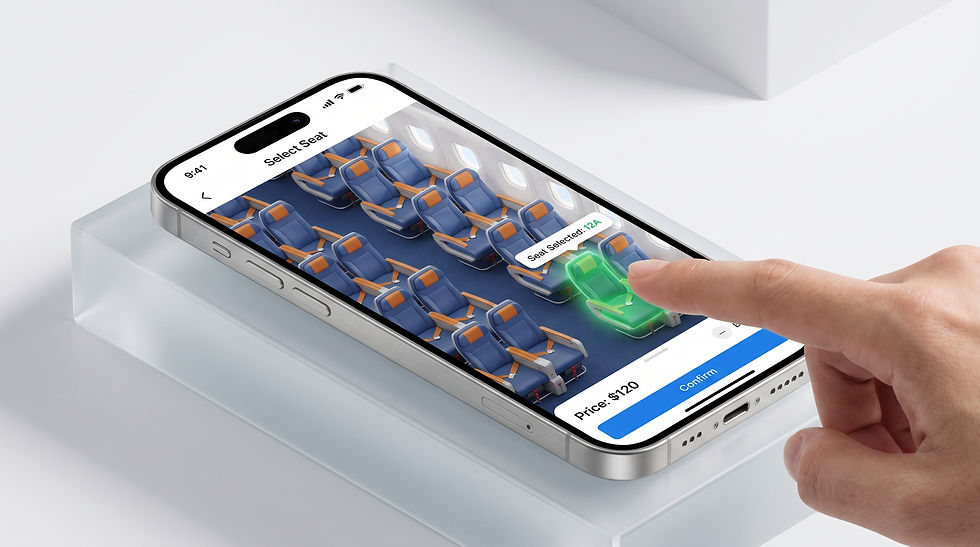
To unlock stagnant ancillary revenue, airlines must change how passengers perceive cabin value during the booking process. By replacing static layouts with web-based 3D visualizations and 360-degree interactive seating experiences, carriers transform their digital booking path from a rigid checkout form into an immersive digital storefront.

The Hidden Cost of Text-Based Seat Upselling
Traditional booking engines rely heavily on text to convince travelers to spend more money. However, standard text descriptions do not evoke emotion or demonstrate tangible physical value. When an economy passenger reads "3 inches of extra legroom," they cannot translate that number into how it will actually impact their physical comfort during a long-haul flight.
This visual disconnect hurts conversion rates. Airline revenue managers know that ancillary products—specifically seat upgrades—carry the highest profit margins in the business. Yet, standard upselling strategies fail because passengers view premium upgrades as low-value financial risks rather than high-value investments in their personal travel comfort.
How 360-Degree Spatial Certainty Drives Passenger Conversions
Immersive technology solves this visibility gap by giving passengers total spatial certainty before they check out. When a traveler can virtually step inside the aircraft cabin, look around at eye level, and compare a standard economy seat directly with a premium class option, the value proposition becomes clear.
Integrating interactive 3D cabin models directly into the web booking path yields immediate financial and operational benefits:
Eliminating Passenger Friction: Customers no longer guess what an exit row or premium seat looks like. They instantly see the exact legroom, window alignment, and proximity to the aisle.
Contextual Upselling Prompts: Displaying a 360-degree interactive pop-up comparison at the exact moment of seat selection triggers impulse upgrades based on real visual desire.
Higher Booking Confidence: Clear visual expectations build immediate trust, reducing the time passengers spend hesitating or abandoning their carts during checkout.

Maximizing the Key Metrics of Airline Revenue Management
For airline executive leadership and revenue optimization teams, the ultimate goal is maximizing the average revenue per passenger (RevPAS). Transitioning from flat booking interfaces to 3D retail experiences shifts the most critical financial metrics in favor of the airline.
Global industry data indicates that airlines integrating interactive 3D seat maps experience an immediate 15% to 20% increase in seat-related ancillary revenue.
Beyond initial upgrade conversion rates, this immersive approach lowers customer service costs. Because passengers know exactly what they are purchasing, airlines see a measurable drop in post-purchase seat changes, passenger complaints upon boarding, and post-flight refund requests. It turns premium sections into self-selling visual assets.
Lightweight 3D Tech Designed for Global Airline Infrastructure
Airlines operate massive, high-traffic digital ecosystems where page load speed, mobile responsiveness, and system stability directly dictate sales success. Modern 3D visualizations no longer require heavy third-party plug-ins, apps, or slow software downloads that disrupt the user journey.
Advanced web-based 3D modeling solutions integrate into existing passenger service systems (PSS) and internet booking engines (IBE) via standard API setups. These lightweight visual assets render instantly on any mobile browser or desktop screen. This ensures that the interactive cabin experience remains fast, smooth, and fully optimized to secure high-volume conversions without slowing down the checkout funnel.
Transforming Standard Inventory into Premium Visual Assets
Airlines can no longer afford to leave their ancillary revenue growth dependent on basic text descriptions and outdated 2D seat blueprints. To capture the full financial potential of premium economy, exit rows, and upgraded cabins, carriers must provide complete visual clarity.
By upgrading the booking journey to web-based 360-degree interactive experiences, revenue managers can move past static inventory sales and establish a highly scalable, visual-first upselling strategy that consistently converts standard travelers into premium buyers.

Turn Your Aircraft Cabin Into a High-Conversion Storefront
At Spherx360, we specialize in designing photorealistic 3D modeling and lightweight, web-based 360 interactive viewing experiences tailored for the aviation industry. Our technology integrates directly into your booking system, giving passengers the exact spatial certainty they need to upgrade instantly.
Ready to see how immersive visual assets can lift your airline's ancillary revenue by 15% or more?
Explore our interactive 3D cabin demo now to experience firsthand how Spherx360 transforms standard bookings into premium upgrades.


Comments